
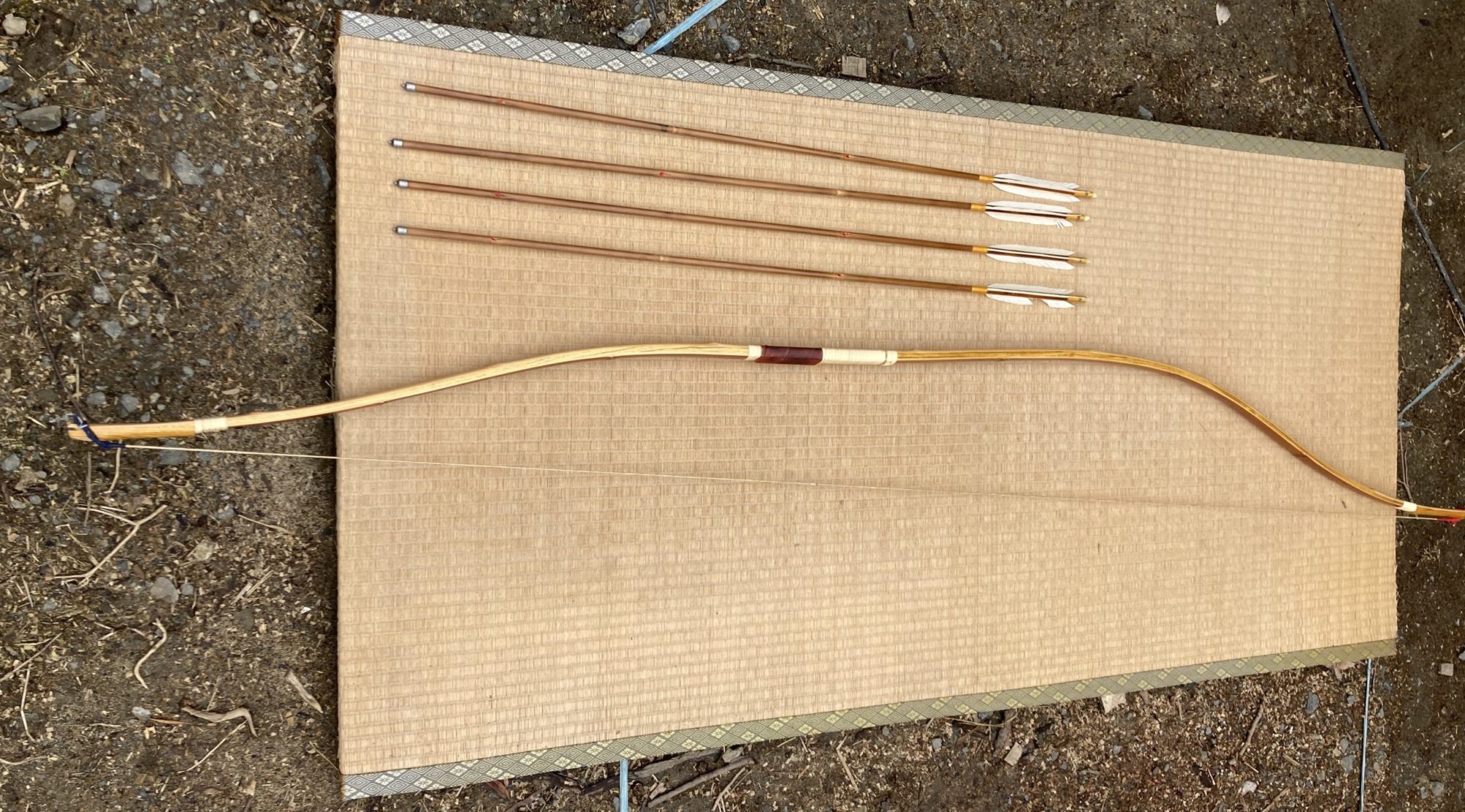
Q.Why is Yumi so long?
A.Because it was originally very strong. Samurai of the 12th century used very strong bows. In todays modern society the shape of the yumi hasn’t changed however bow strengths are much lower. Meaning that in present day a shorter bow would theoretically be fine.
The reason a strong bow needs to be longer is for the same reasons as why an English longbow was made long too.
Q.Why is the grip of a yumi below the middle of the bow?
There are many theories on this, but I will explain my understanding. In the old days, a bow was just a stick with no window or stabilizer. An arrow shot from this bow would be at an angle, requiring the archer to shift his aim away from the target. In this case, the arrow would hit the bow and the shooter’s hand, reducing accuracy and power at the same time.
The Yumi is shaped like this to solve these problems. When an arrow is ejected normally from a bow with a grip on the bottom, the force pushing the nock point downward is applied and the arrow is ejected at an angle, pointing upward. To compensate for this, you need to apply a force that pushes the top of the grip toward the target and pulls the bottom toward you. When such a force is applied, the left hand, which is the arrow rest, will move away from the arrow on release and will not interfere with the arrow’s ejection. It works just like the arrow rest on a modern hunting compound bow.
Its grip position was about 3/5 of the way down, which was also the point where the bow vibrated the least. Also, because the Japanese bow has no window, the arrow will strike the bow and deflect sideways if nothing is done. This is solved by applying force in the direction of twisting the bow.
In other words, the Yumi needs to be twisted and released while at the same time applying an upward push.
And it does one more good thing. The energy of the twisting and upward pushing force is transferred to the arrow, and you can add that energy to the bow’s power.
Modern bows have a window to eject the arrow straight. Modern bows have stabilizers to control vibration. But Yumi is an attempt to solve these functions with its form alone.
Now, I have talked only about the good points of Yumi, but that is not fair, and if Yumi were the best in the world, it would be the most popular in the world. But the reason why this is not the case is that there are some bad points.
First of all, it is long and in the way. A long bow is less efficient because kinetic energy is used to move the bow itself. This is especially true when the draw weight is weak (although you can take advantage of the long length and use it as a spear with a blade on the end).
The long draw length also makes aiming more difficult, since you cannot aim at two points. And since it requires a lot of technique, it takes time to become a full-fledged player.
これは様々な説がありますが、私の理解を説明します。昔の弓はウインドウもスタビライザーもないただの棒でした。この弓から放たれる矢は斜めになり、射手は狙いを的からずらす必要があります。この場合矢は弓と射手の手にぶつかって射出されるために精度が落ちると同時に威力も落ちます。
Yumiはこれらの問題を解決するためにこの様な形になりました。下の方にグリップがある弓から普通に矢を射出するとノックポイントを下に押す力が加わり、矢は上方向を向いて斜めに射出されます。これを補正するにはグリップの上を的方向に押し、下の方を自分の方向に引く力を加える必要があります。その様な力を加えるとアローレストである左手はリリースの時に矢から離れ、矢の射出を邪魔しません。それはちょうど現代のハンティング用のコンパウンドボウのアローレストの様な働きをします。そのグリップの位置は3/5程の位置にあり、弓の振動が最も少ない点でもありました。また、和弓はウインドウがないため、何もしないと矢が弓にあたって横方向にそれてしまいます。これは弓を捻る方向に力を加えることで解決します。
つまりYumiは捻ると同時に上を押す力を加えながらリリースする必要があるのです。
そしてそれはもう一つ良いことがあります。捻る力と上に押す力のエネルギーは矢に伝わり、弓の力にそのエネルギーを上乗せすることが出来ます。
現代の弓は矢をまっすぐに射出するためにウインドウがあります。現代の弓は振動を制御するためにスタビライザーがあります。しかしYumiはこれらの働きをその形だけで解決することを試みたものなのです。